
Pain, Fear, or Grief? How to Read Patient Cues That Look Identical
- Audhiyanth Arvind
- 23 hours ago
- 4 min read


Reading patient cues means moving past a single observation — a patient goes quiet, looks away, guards their body — to the pattern underneath it. And here’s the trap that catches almost every new nurse: pain, fear, and grief can produce the exact same surface cue. Three completely different things are happening inside the patient, and they all look like “withdrawn and giving short answers.” The skill isn’t memorizing which cue means what. It’s slowing down enough to ask what the whole pattern is telling you — and then checking it against the patient, out loud.
Why one cue points three directions

A patient who has gone silent and turned toward the wall is giving you a real cue. It just isn’t a specific one. This is where a lot of new grads get stuck, and it’s completely understandable — nursing school is very good at teaching you to gather data, and much quieter on how to interpret a pattern of it. You leave school able to document “patient withdrawn, minimal eye contact” with total accuracy and no idea what it means.
That gap isn’t a personal failing. It’s a curriculum artifact. Recognizing it is the first step to closing it.
How the three separate
Pain usually has a location and tracks with movement
Pain tends to be tied to the body in space. It changes with position. It has a where. When the quiet lifts as the patient settles into a different position, or tightens when they shift, you’re likely looking at something physical — assess it as such.
Fear attaches to what comes next
Fear lives in the future tense. It shows up as scanning the room, bracing, and the half-question that trails off — “what happens if…”. The patient isn’t reacting to now; they’re reacting to the diagnosis, the procedure, the unknown thing on the other side of this moment.
Grief pulls inward and backward
Grief is heavier and slower. It’s tied to a loss — sometimes one the chart doesn’t mention, sometimes one that hasn’t officially happened yet. Where fear leans forward and braces, grief settles down and turns away.
The skill isn’t memorizing which cue means what. It’s slowing down enough to ask: what is this whole pattern telling me?
The step almost everyone skips: check it out loud
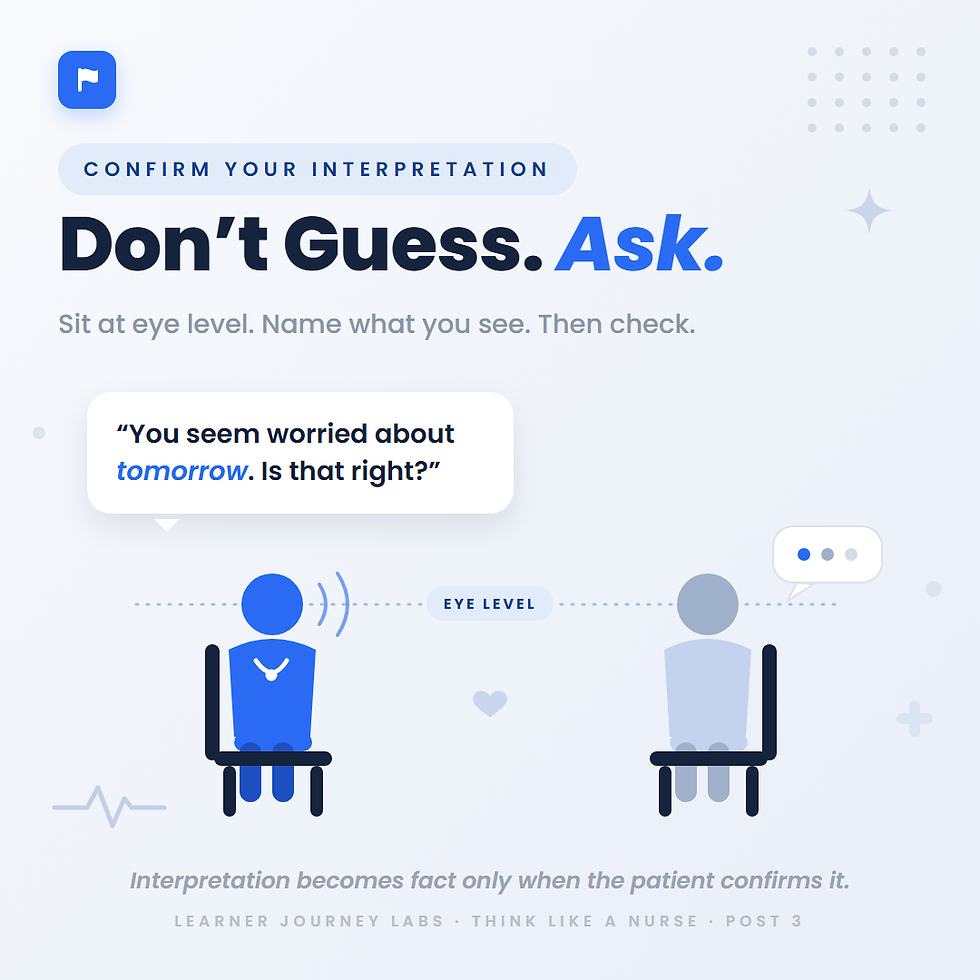
Here’s the part that separates a good read from a guess. You don’t get to keep your interpretation private. Once you have a hypothesis — “I think this is fear about the results” — you say a version of it back to the patient. “You seem to have a lot on your mind about tomorrow. Is that where you are?” Sometimes you’re right and they exhale. Sometimes you’re wrong and they correct you, which is arguably more valuable, because now you have the real answer instead of a confident wrong one.
Let me steelman the other side

Some experienced nurses will tell you that over-interpreting is its own hazard — that not every silence is a symptom, and that hovering over a patient’s emotional state can be intrusive when they simply want to rest. That’s a fair caution. Reading cues well isn’t reading meaning into everything. It’s holding your interpretation loosely enough to be wrong, and checking before you act on it. The confirmation step is exactly what protects you from projecting a pattern that isn’t there.
The Dr. R lens
In the scenes we built for the Think Like a NURSE series, we kept the surface cue identical on purpose across different scenarios — same quiet, same guarded posture — and changed only what the patient said next when a nurse stayed and asked. That’s the whole lesson in one design choice: the cue doesn’t hand you the answer. New grads often tell me the pattern finally clicked not when they memorized a table, but the first time a patient corrected their read — and they realized the correction was the point, not a failure.
Frequently Asked Questions
What does “reading patient cues” mean in nursing?
Reading patient cues means interpreting the pattern behind an observation, not just recording the observation. A single sign — silence, guarding, short answers — can point to pain, fear, or grief. Reading cues is the interpretive skill of figuring out which, then confirming it with the patient before acting.
How do you tell pain, fear, and grief apart?
Pain usually has a location and changes with movement or position. Fear attaches to what comes next — the procedure, the diagnosis — and shows as scanning or bracing. Grief pulls inward and backward toward a loss, and feels heavier and slower. The pattern, not any single cue, points the way.
Why do new nurses struggle to read cues?
Nursing education emphasizes collecting data more than interpreting patterns. New nurses can accurately document a behavior yet feel unsure what it means. Cue interpretation is a distinct skill that develops with exposure, pattern practice, and the habit of checking a read against the patient rather than assuming.
Should I tell the patient what I think a cue means?
Yes — carefully. Offer your interpretation as a tentative observation (“You seem worried about tomorrow — is that right?”) rather than a conclusion. This confirms or corrects your read, keeps the patient in control of their own story, and protects you from acting on a pattern that isn’t actually there.



Comments