
Do Higher Test Scores With AI Mean Real Learning?
- Audhiyanth Arvind
- Jul 2
- 5 min read

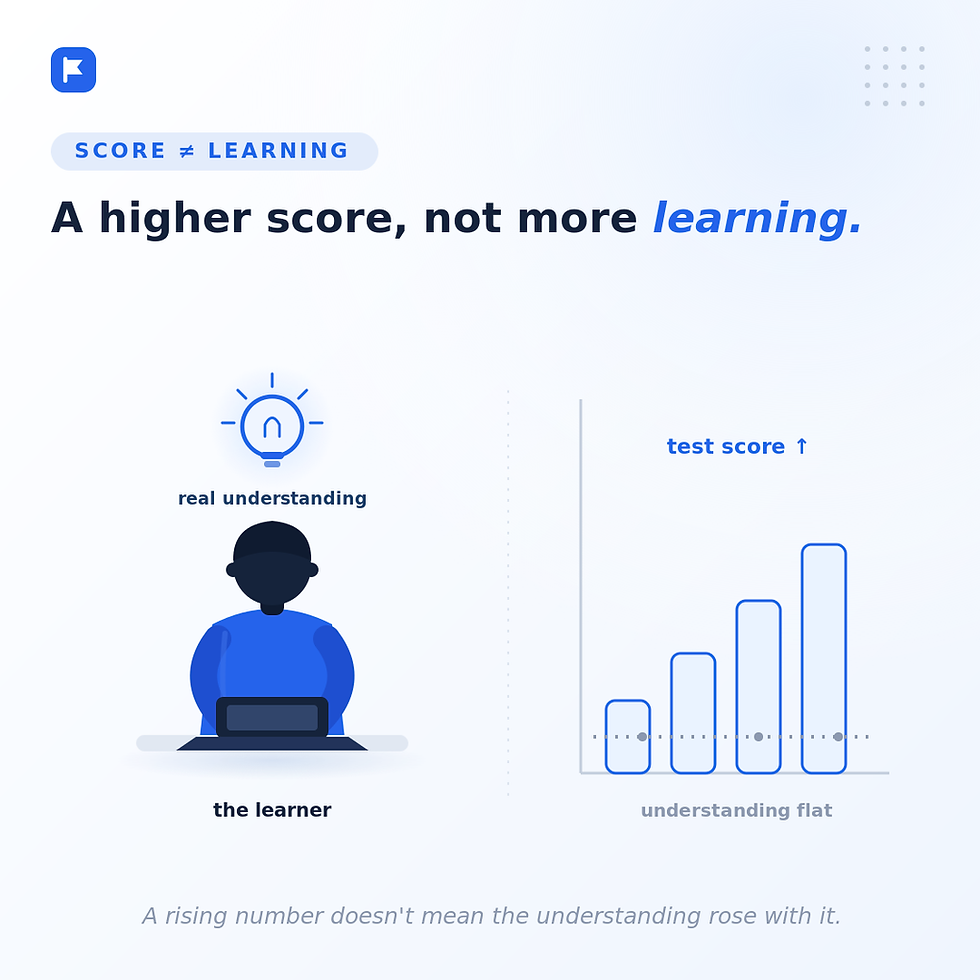
Do higher test scores with AI mean real learning? Not necessarily — and the gap between those two things is where a lot of AI-in-education enthusiasm quietly goes wrong.
You'll see reports of big test-score jumps when students use AI-powered instruction. I believe the numbers can move; AI is genuinely good at finding gaps and adapting practice in real time. I'd hold any specific figure loosely, but the direction is plausible.
Here's the catch. A test measures performance on a particular day. Learning is whether the understanding is still there — and usable — weeks later, without the AI in the room. Those aren't the same measurement, and treating them as one is the trap.
Key takeaways :
AI can raise test scores quickly by finding gaps and adapting practice — but a higher score isn't automatically deeper learning.
• A test measures performance on a day; learning is whether understanding holds and transfers later, without the AI.
• The "measurement trap": we reward the number because it's easy to see, and stop asking what the brain actually had to do.
• What to track instead: retrieval, transfer, and explanation — not just the score.
Let me walk through why scores can rise without learning, the trap that hides it, and what to measure instead.
Why AI Can Push Test Scores Up
Give AI credit where it's due. A well-built AI system can spot exactly where a student is weak, serve targeted practice, and adapt in real time. Do that often enough and a test number will usually climb. That part is real, and it's worth using.
But notice what that process optimizes for. It optimizes for getting more items right on the assessment in front of you. If the assessment rewards pattern-matching, speed, or recall of a specific format, AI will help a student get very good at exactly that — quickly.
The score goes up. The question is what went up with it.
The Harder Question: Learning, or Just Testing Better?

There's a difference between a student who understands an idea and a student who has gotten efficient at passing its test. Both produce a higher number. Only one produces durable capability.
When a student optimizes for the test with AI assistance, performance improves on cue. The underlying understanding may move a lot, a little, or not at all — and a single score can't tell you which. That's not a knock on the student or the tool. It's a limit of what a test actually measures.
So the better question isn't "did the score rise?" It's "what did the brain have to do to get there?" If the answer is "not much," the score is borrowed, not built.
The Measurement Trap

Here's why this is so easy to miss. Scores are visible, fast, and comparable. Understanding is slow, messy, and hard to see. So we reward what we can measure and quietly assume it stands in for what we can't.
That's the measurement trap: optimizing the proxy instead of the goal. The number becomes the target, and the moment a number becomes the target, there are always faster ways to move it than actually learning. AI just makes those faster ways more available. It's the same dynamic behind study-adjacent behavior — activity that produces the appearance of progress without the substance.
A rising score is only good news when it's evidence of learning. It's a problem when it becomes a substitute for it.
What Real Understanding Looks Like

If a score on a day isn't enough, what is? Three signals are harder to fake and much closer to real learning:-
Retrieval — can the student produce the idea from their own memory, not just recognize it on a page?
Transfer — can they use it on a new problem that doesn't look like the one they practiced?
Explanation — can they say why, walk through the reasoning, and defend a choice?
None of those show up cleanly on a typical multiple-choice score. All of them show up when you design assessment to ask for them. That's the shift: measure what the brain had to actively do, not just whether the final box was ticked.
How to Design — and Assess — for Understanding

This is where it becomes practical. A few moves keep the score honest:
Ask students to explain their reasoning, not just submit an answer. Build in delayed checks — revisit the idea a week or two later, without the AI, and see what survived. Use transfer tasks that change the surface but keep the underlying concept. And let AI do what it's good at — generating practice, surfacing gaps, giving feedback in the moment — while the assessment still asks the human to think.
Used that way, AI and a rising score can both be real wins. The design is what keeps the number meaning something.
The Dr. R Lens
In the Learner Journey Framework, I don't treat a score as the finish line. I treat it as one data point that has to be checked against the others.
So when someone tells me AI raised test scores, I'm glad — and I ask the second question immediately: did understanding rise with it, or did we just get faster at the test? The first is learning. The second is performance wearing learning's clothes. The way you tell them apart is to measure retrieval, transfer, and explanation — the things a score alone can't see.
Higher scores are worth celebrating only when they're evidence of thinking, not a replacement for it.
Frequently Asked Questions
Can AI improve test scores?
Yes, often. A well-designed AI system can identify a student's gaps, serve targeted practice, and adapt in real time, which tends to move a test number. The important caveat is what that improvement represents: getting more items right isn't automatically the same as deeper, more durable understanding. Treat a score gain as a starting question, not a conclusion.
Do higher test scores mean students learned more?
Not necessarily. A test measures performance on a given day; learning is whether the understanding holds and transfers later, without the AI. A student can optimize for the test and raise the score while the underlying understanding barely moves. A higher score is good news only when it's evidence of real learning, not a substitute for it.
How do you measure real understanding, not just test results?
Look for three things a score alone misses: retrieval (recalling the idea unaided), transfer (using it on an unfamiliar problem), and explanation (saying why and defending the reasoning). Build delayed, AI-free checks and transfer tasks into assessment. Those signals are much closer to durable learning than a single performance number.
Is using AI to raise scores a bad thing?
No — it depends on the design. Letting AI find gaps, generate practice, and give feedback is a genuine strength. The risk is optimizing only for the score and assuming understanding came along for free. Keep AI in the practice loop, but design assessment so the human still has to think.
Closing
AI can move a test score, sometimes dramatically. That's worth using — and worth questioning. Because the goal was never a higher number; it was a learner who can still think when the number, and the AI, aren't there. So before we celebrate the score, it's worth asking the quieter question: what did the brain actually have to do to earn it?
Want the model behind this? Explore the Learner Journey Framework — or talk to Learner Journey Labs about designing assessment that measures real understanding, not just test performance.


Comments